Finland woman
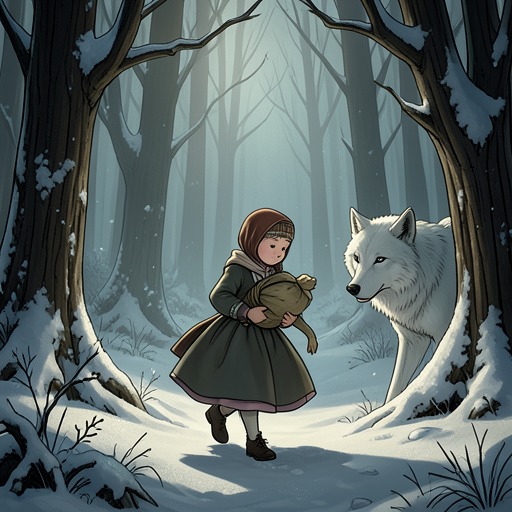
The Snow QueenThe Finland woman is a shrewd, practical guide who identifies the cause of Kay’s captivity and sends Gerda toward the Snow Queen with no magical weapon, but with a clearer understanding of the strength she already possesses. Her knowledge matters; so does her refusal to make Gerda’s rescue depend on power borrowed from someone else.
Arrival and Character
The Finland woman enters the story after the reindeer carries Gerda north from the Lapland woman’s hut. The message for her is written on a dried stock-fish because the Lapland woman has no paper. Gerda and the reindeer reach Finland beneath the northern lights, and knock at the chimney of the Finland woman’s hut, which has no door above ground. The odd entrance establishes a remote, materially constrained setting in which ordinary conveniences are scarce and useful knowledge travels by improvised means.
Inside, the heat is so intense that the Finland woman wears scarcely any clothes. She is described as small and dirty-looking, but her practical attentiveness is immediate: she loosens Gerda’s dress and removes her fur boots and mittens so the child can bear the heat. She also places ice on the reindeer’s head. The actions are specific, physical care, offered to two travelers arriving from the cold rather than as a display of authority.
She reads the message three times, commits it to memory, and then puts the fish into the soup because she knows it is edible and wastes nothing. The message has served its purpose without becoming a possession to preserve. When the reindeer tells his own story first and then Gerda’s, the Finland woman listens with bright, clever eyes but says nothing. Her silence is not a lack of understanding: after hearing the request that follows, she consults an inscribed skin and supplies the crucial information.
Knowledge of Kay’s Condition
The reindeer asks whether the Finland woman can make Gerda as strong as twelve men, invoking her reputed ability to tie all the winds of the world with a piece of twine. In his account, loosening one knot brings a fair wind, a second makes it blow hard, and loosening the third and fourth unleashes a storm capable of uprooting forests. The scale of this power makes his request seem reasonable to him, but the Finland woman rejects its premise: such strength would be of little use.
She takes down a large skin marked with strange characters and reads from it until perspiration runs down her forehead. Her answer identifies the hidden cause of Kay’s apparent contentment in the Snow Queen’s company: he likes everything there because a shard of broken glass is in his heart and another little piece is in his eye. Until these fragments are removed, he will not become a human being again, and the Snow Queen will retain her power over him. The Finland woman thus distinguishes Kay’s apparent preference for his surroundings from the condition that has distorted his response to them.
This explanation turns the rescue into a problem of access and recognition, not a contest of physical force. The Finland woman knows what must be undone, but does not claim she can do it herself. Her knowledge reveals the stakes while leaving the necessary action to Gerda.
Gerda’s Strength and the Instructions
When the reindeer asks once more for something to help Gerda overcome the Snow Queen’s power, the Finland woman says that she cannot give the child greater power than she already has. She points to what Gerda has managed despite traveling barefoot: people and animals have been obliged to serve her, and she has made her way through the world without shoes. The source of this strength, she says, is Gerda’s purity and innocence of heart. If Gerda cannot reach the Snow Queen and remove the fragments from Kay, no one else can help her.
The answer is not a promise that the task will be easy. It defines both Gerda’s capacity and the limit of the Finland woman’s aid: assistance can explain the danger and bring Gerda near it, but cannot substitute for her. The Finland woman gives the reindeer precise directions, telling him to carry Gerda two miles to the beginning of the Snow Queen’s garden and set her down beside a large bush covered with red berries. She also tells him not to linger in conversation and to return as quickly as possible. Practical instructions replace the extraordinary strength the reindeer had hoped to obtain.
The reindeer carries Gerda away at speed. When she realizes she has left her boots and mittens behind, he does not dare stop; he reaches the red-berried bush, kisses her, and runs back. The Finland woman’s guidance therefore brings Gerda to the threshold but does not accompany her into the next danger. Gerda must face what follows herself.
Return and Narrative Role
After Gerda and Kay leave the ice palace, they return to the Finland woman first. She warms them in the hot room and gives them directions for their journey home. This later visit completes the practical pattern of her help: first she prepares Gerda to continue toward Kay, then, once the rescue has succeeded, she helps the children begin the return journey.
The Finland woman’s part in the story is brief but structurally decisive. She converts an alarming mystery into a comprehensible condition, refuses a show of borrowed power, and directs Gerda to the place where her own resolve must act. Her hospitality is expressed through heat, food, ice for the reindeer, and guidance; her authority rests on knowledge that serves others without taking over their choices. The return to her hut also marks a change in the children’s passage: the journey away from the Snow Queen has begun, and practical care now supports their way back.